
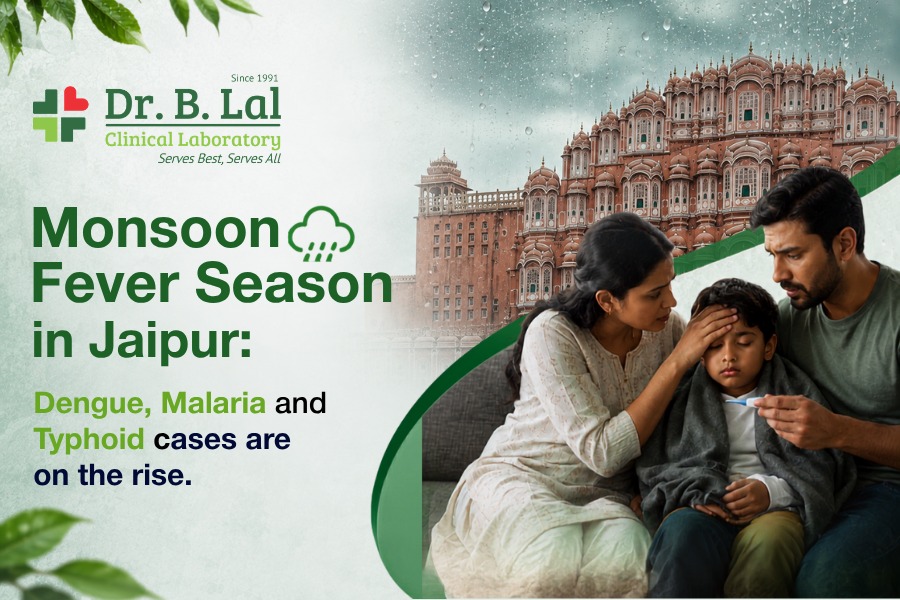
JAIPUR, Rajasthan — The rains have been good to Jaipur this year, and that’s part of the problem. Every monsoon, the same pattern plays out across the city — water collects in places nobody thinks to check, and within a couple of weeks the fever OPDs start filling up. Dengue, malaria and typhoid don’t arrive one at a time either; they overlap, which is exactly why so many people end up treating the wrong illness for the first few days. Dr. B. Lal Clinical Laboratory, one of Rajasthan’s leading diagnostic chains, is using this window to push a simple message: don’t guess a fever, test it.
Why Jaipur Sees This Every Year
There’s nothing mysterious about why Jaipur gets hit hard. Short, heavy bursts of monsoon rain followed by long dry spells give mosquitoes exactly the standing water they need to breed — coolers, terrace tanks, half-built plots, tyre yards, even a neglected flowerpot.
Aedes mosquitoes, which spread dengue, and Anopheles, which spreads malaria, both thrive in this cycle. Health department records over the years have repeatedly shown Jaipur among the worst-affected districts in the state once the season turns, with numbers usually climbing from July and staying high right through September–November. Typhoid follows a slightly different route — it spreads through water and food, not mosquitoes — but monsoon flooding does the same damage by contaminating supply lines in low-lying colonies.
The Fever Isn’t Always What It Looks Like
This is where most delays happen. Dengue, malaria and typhoid all start the same way — with a fever — so people wait it out, assume it’s viral, and lose the early window when a blood test would have given a clear answer. Here’s roughly how each one tends to show up:
- Dengue usually hits fast — high fever, a headache that sits right behind the eyes, body and joint pain that feels worse than a normal flu, sometimes a rash. If it progresses, watch for repeated vomiting, stomach pain, bleeding gums or a platelet count that’s dropping.
- Malaria tends to come in waves — chills first, then a spike in temperature, then heavy sweating as it breaks, and the whole cycle often repeats every two to three days.
- Typhoid builds more slowly — fever that climbs over several days rather than spiking suddenly, along with stomach discomfort, low appetite and general weakness.
Check our Monsoon Package Dengue, Malaria Tests in Jaipur
None of these should be treated with whatever’s left over in the medicine cabinet from the last illness. Each one needs its own confirmed diagnosis and its own line of treatment — mixing them up just delays recovery.
What Actually Helps at Home
- Check coolers, buckets, flowerpots and terrace tanks for standing water — once a week, not once a season
- Keep repellents and nets handy, especially around dawn and dusk when Aedes mosquitoes bite most
- Stick to boiled or properly filtered water, and go easy on street food and cut fruit for the next few weeks
- If a fever hangs around past a day or two, don’t wait it out — see a doctor
- Get tested early, particularly for kids, elderly family members and anyone already managing another health condition
What the Lab Is Doing About It
Dr. B. Lal Clinical Laboratory has widened access to dengue, malaria and typhoid panels across its labs and collection centres in Jaipur and other Rajasthan cities this season, with home sample collection for anyone who’d rather not step out. Alongside that, the lab is running on-ground awareness efforts in the parts of the city that flood first and worst — the idea being to get people testing early instead of self-diagnosing and hoping for the best.
“Every monsoon we see the same thing — people treat a fever like it’s routine, and by the time they come in for a test, they’ve already lost a few days. In a city where dengue, malaria and typhoid are all doing the rounds at once, that gap matters. The symptoms can look alike; the treatment never is,” said a senior pathologist at Dr. B. Lal Clinical Laboratory.
About Dr. B. Lal Clinical Laboratory
Dr. B. Lal Clinical Laboratory is a pathology and diagnostics chain based out of Jaipur, running a wide network of labs and collection centres across Rajasthan and neighbouring states, offering everything from routine health check-ups to specialised diagnostic testing.
Reviewed By:- DR . KARAN MAURYA –
LAB DIRECTOR AND HEAD OF CENTER OF EXCELLENCE – LABORATORY MEDICINE DR B LAL CLINICAL LABORATORY
